
NXP and China, a frail relationship.
Back in October 2018, Wingtech was the largest contract ODM smartphone company in China. They had money, and they were going to use it. NXP? Well basic transistors – they’re legacy devices right? Nobody in the west makes money at that? Anything that one might need can be bought in China cheaper.
Many thought it, but were wrong about everything except the aggressive competitive environment.
Old Guard
NXP represents a European economic Oak. It grew slowly, it is strong and tough. For the people who knew what it was about, validity was never in question. Tracing way back, NXP like ASML, has origins in Phillips, Mullard and others. These companies forged the pathway from vacuum tubes into solid state electronics. The same physics, chemistry and material science that make EUV lithography work – underpins the semiconductor design itself.
Every GPU is made of transistors. At face value it seems more advanced. Technically it is. A design more applicable to the needs of the day. Whilst a GPU may be the technology of the instant, it will be obsolete tomorrow because of fashion – or changing need. In a complex VLSI SoC high turnover environment, this is good perhaps. More opportunity for change. New business. New jobs.
A good discrete transistor will still be valuable three decades from now. Like Sushi and Rice, Sushi is gone tomorrow. Rice can be bagged up today and it’ll still be good next year. If you think you might be hungry one day, that rice is an attractive proposition.
Car manufacturers had been loyal to NXP, because they knew the reality. They can buy from China, but the quality is variable. It can be cheaper but when companies find their immensely complex manufacturing lines stopping, because components are not up to the job, new layers of quality control and inspection are required. These costs cannot be eliminated. The pressure on manufacturers to keep complex lines running is immense. Nevertheless, in competition with the slippery scales of the Chinese dragon, anything to do with discrete semiconductors looked lossy and unwise as an investment prospect for a hedge fund.
In Europe it is not the job of the car manufacturers to also make semiconductors. Here, we say that semiconductor companies must serve the needs of all industries. In China, if car companies need semiconductors to build cars, then it is down to them. Vertical integration manages quality control and production compatibility but restricts the breadth of capability. In Europe we depend on our investors to maintain corporate strength and security of supply. If investors deem that a technology is obsolete, it becomes a competitive victim, regardless of its actual obsolescence.
The Chinese economy is an aggressive environment and it works differently. Companies rise and fall quickly. Vertically integrated businesses are formed from the assets of defunct entities that failed to compete. This is a system lightly curated by the state. Lots of failures happen, but the underlying assets remain protected. The corporate structures evolve over time in this aggressive environment. The very DNA of these business entities is evolved for combat. Tightly focussed, efficient and hardened. Like a caber to breach a vast castle wall.
Rescue Capital
By comparison with NXP, Wingtech is a plucky upstart. Everyone knows that China can scale quickly, but there is always fallout. There’s no shortage of brand new bridge collapses, flaming trains, dams in full flush. It can be done, but there is always a price. Of course investors love it, because the stock price is severable. Even if the disaster is moderate, statistically – the loss is rarely total.
NXP can trace its roots to companies that developed radar in WWII, underpinning countless different product offerings over perhaps a century of business. By contrast, Wingtech is a product of the mobile phone boom. Founded marginally before the emergence of the smartphone, it is more a result of cable manufacture and a global need for wireless earbuds. This is a highly profitable market. It demands considerable toolmaking skills. High volume manufacturers require progression press tooling and injection mould tooling. Automatic assembly, soldering, gluing and manual inspection. High value products with solid demand. A huge native market in China and beyond. Technologically, most of these products depended on just a few VLSI SoC chip designs that lasted 20 years.
A company comparable to Wingtech from the Mullard era in the UK would perhaps be Pye. Pye was undoubtedly a respected scientific and technical company emergent from the Cavendish Labs. Pye was involved in the development of radio, but they were at a technology level more that of a mechanical and production nature. They would design and build radios, but they would obtain their valves from Philips (to become NXP). In the same way Wingtech designed smartphones but would specify chipsets from HiSilicon in their designs, building them into affordable smartphone products for a Chinese market.
Fundamentally NXP and Wingtech are in different places technologically. Unlike ASML, NXP probably didn’t have a vast amount of technology that was unavailable in China. They would have had critical knowhow for maintaining manufacturing yield but none of those issues stem from new physics or chemistry. These things are about corporate dedication, staff discipline and co-operation. NXP always maintained its hold over the European automotive and “high reliability” markets. Partly due to perception, partly due to practical experience, NXP has survived the onslaught of vanishingly small profit margins in an aggressive competitive environment. Primarily, this is due to consistent excellent core competence and quality. The gold standard.
It is possible to think that the mobile phone boom enabled Wingtech to forward $3.5 billion for a 75% share in NXP, but for them this would be broadly equivalent to a full years revenue at the time of purchase. The Chinese government had investment in Wingtech. They do in many Chinese companies. They were a likely lender. It is difficult to think that this was an ordinary takeover. Beyond the corporate entities themselves were global states and interests with powerful influence and conflicting desires. However one evaluates the situation, at the time of sale the two companies had similar sales revenues. Even if Wingtech had the edge financially, NXP was several times the size of Wingtech in terms of manpower. The turnover of the two business entities was very different.
Apart from money, Wingtech would likely have had the ability to deliver semiconductor packaging technology. This specific capability involves taking finished silicon wafers or dice, connecting them electrically to a lead-frame (the legs that stick out) and encapsulating them in a plastic package. This is very much a mechanical engineering task, mould and toolmaking, process automation – the ordinary production line. Undoubtedly an important part of the semiconductor business, but not semiconductor physics, junction design, functional design, lithography, chemical and physical processing. The latter are clearly and significantly more difficult. Not beyond Chinese capability, but until Wingtech purchased NXP, not a Wingtech competence.
Worlds Collide
The broad relationship between the two organisations developed. A rich, but less experienced, lower technology buyer taking a controlling stand in an mature, well developed, highly competent organisation. It is said that the relationship started well, but it is not entirely surprising that difficulty was found. The comparison with the Philips takeover of Mullard seems quite stark. It highlights the cultural differences in business DNA. The Mullard name still exists today, albeit the trading entity has gone. Philips engaged in partnership with Mullard in the 1920’s, quickly found collaborative value and gradually bought the company entirely. Philips and Mullard nurtured one another. Mullard continued trading for another sixty years – at least. Wingtech was attempting to fire all of the key executives within six years. Caber meets bastion.
One wonders how this relationship could have gone well. There is no doubt that China could have benefitted greatly from a successful relationship with Europe. However it happened, Europe has already lost many of its former toolmaking skills. The critical relationship between the product designer and a toolmaker is largely gone. Somehow there is a belief that AI will fill this gap. The ability of a demanding human dreamer to negotiate with a human pragmatist who can deliver anything, albeit with varying degrees of pain, should never be underestimated. In that space there will always be fresh new customer demand for innovative thoughtful products.
More significantly, Wingtech could have gained access to European technology. If Wingtech had wanted to develop high quality general purpose products outside of the mobile phone arena then it could have gained access to NXPs high quality semiconductor devices. Broadly though, most of those technologies are already available in China at a cheaper price point and with Chinese language support.
In paradise, perhaps, it is possible to think that Wingtech or Chinese state money could have been used to expand NXP facilities such that Wingtech could compete inside China without HiSilicon. No reasonable thinker is likely to give that possibility more than a moment of consideration.
For Wingtech, it could have been quite lucrative, because of course – even a little money for nothing is always good. In time too, it could have been more of the same for a China wanting to grow in breadth at the existing level of strength. Unsolicited technology transfer all at once is always seen as industrial espionage. Over several decades as a part of natural diffusion, technology transfer is much more like collaboration and mutual respect.
The Fallout
Thinking specifically about the relationship between ASML and NXP; When a senior part of the family one bought into happens to be bona-fide royalty, does it really benefit one to be seen as the invader, even if the veil could be thin? When NXP ousted their Chinese CEO Zhang Xuezheng, Chinese state reciprocity was as swift as the Dutch state assertion. The United States export control and tariff scheme may have been an influencing factor, but China was insistent. Dutch devices could not ship from China. In the sense of escalation, this was a dramatic reaction. One year on, component lead times are still stated to be at least six months with no stock – except that nominally maintained by China.
It is particularly interesting that the Chinese state has been upset by the action of the Dutch state acting to offer some degree of protection to NXP. China no doubt has some difficulty with not being able to access EUV lithography. Whilst it is a state obligation for the Dutch government to enforce the rules, the rules themselves are internationally agreed. The Chinese state knows this, so it is unfair to pressure the Dutch directly no matter how amenable the Dutch may wish to appear. Most notably, with the Chinese state heavily involved in Wingtech, it seems unreasonable of them to expect for the Dutch government to remain distant from the affairs of NXP. If the buyer of NXP had been Western European, the Dutch government could have remained distant because Western European nations are less likely to exert state pressure through business. The fact that Western culture tries to avoid state involvement in business decisions, rightly, does not mean that it cannot offer protection when other cultures can use such involvement for advantage.
At the time that the Chinese CEO Zhang Xuezheng sought to fire the senior executives of NXP, they were to be fired for resisting the CEOs initiative to move semiconductor manufacturing away from Dutch plants. It was necessary for this business to be transferred into Chinese companies other than Wingtech who have no such native Chinese capability themselves. It must have been a double blow for Wingtech to discover that NXP could not be used to evade trade tariffs into the USA, a likely motive for the critical mind. Indeed, to discover that big European companies have staff with sufficient autonomy to resist such a move and call for state help, must too have been something of a shock.
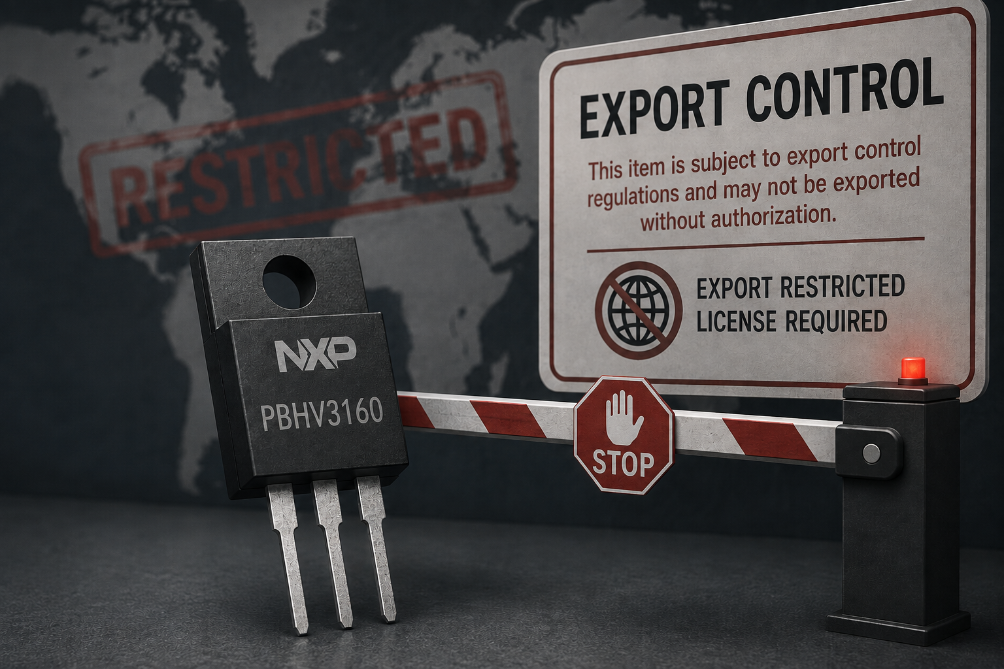
Approaching a year on from the critical October 2025 split, there is more clarity about the facts, but the direction remains murky. A clear reason for writing this assessment is the direct availability of specific semiconductor devices. NXP offered the market products that were unique. A typical example is the PBHV2160 and PBHV3160 discrete high voltage bipolar junction transistors. These are offered as a matched complimentary pair. Complimentary matching is not essential, but it is certainly convenient and a design constraint for physical size and complication. No-one else has such a part for a voltage rating as high as 600 volts. Applications include instrumentation and metrology for power electronics including drivetrains, systems, machines, radio or acoustic transmitters. Almost any situation where physics drives a designer towards high voltage electricity.
Some of the more mainstream devices began to ship after a six month delay, but any reasonable product designer had a need to migrate swiftly to alternative devices and solutions to keep products shipping. In some cases there are drop in replacement components. In others the problems are greater. Once the sometimes complex effort to migrate has been made, a product designer cannot justify the effort and cost to migrate back.
It’s a Long Tail
The wider costs to business including NXP, but especially in the automotive sector, is immense. Not only are product designers forced into detailed design changes, there are costs due to failure to deliver. With limited potential for direct substitution, product designs face significant change. NXP inevitably face a loss of custom. In the final analysis it is less that these customers do not wish to use NXP components, and more that they are unable to justify a return to them.
Taking the broadest view, these costs have emerged from a Western failure to recognise the inherent value of a company like NXP. This mistake is compounded by an ever expanding need for Chinese growth, and her desire to lever a tactical advantage from state ownership of foreign assets. The costs aren’t entirely Western either. Although China can plan to offset her corporate losses against her export gains in the automotive sector, it seems she would apply Western values to losses in China. We know this because she insists that we should not apply Chinese values and defend Western business. If we ever did embrace those methods they know everyone would lose.
Until the dust fully settles, it is likely that availability issues with NXP semiconductors will remain. Even if batches of components become available for purchase, it is difficult to think that consistent availability will return. The natural tendency for corporate buyers becomes that of lifetime buying. Suddenly a reduced shipping schedule becomes consistent unavailability for smaller emergent western business. The West hasn’t previously needed internal market controls, because market participants have not needed to engage in hoarding due to supply side restrictions.
Looking at the cost and availability of vehicles in Europe now, in the recent past and the near future it is difficult to think that a standard “best cost” hatchback car is easy to buy from a Western or European company. Partly that is due to environmental restrictions, but it is also to do with controls over international trade. The situation with NXP represents a significant part of that equation.
Was it strictly necessary for China to move so dramatically? It seems that China’s direction is largely unchangeable, by them or the West. The West is on a path of natural decline, much of it self imposed. China has worked hard for the money and power it now justifiably holds. China may disagree, but it doesn’t seem right that their power should give them a veto over our future. The West still holds some jewels, and it is right that we should protect them as such. It would never have been reasonable to lend that which is most precious at the outset. There should be a lesson here for us. Nothing seen would lead us to think that instinctive trust is wise or mutually beneficial.